
The Sagnes tomme wants its PDO: what it costs, what it earns
Eleven producers, 96 tonnes a year, a PDO application lodged in 2024. Set the cost of the specification against the premium per kilo, and two of the eleven do not cover their costs. They know it.
Théo Brissac5 min read
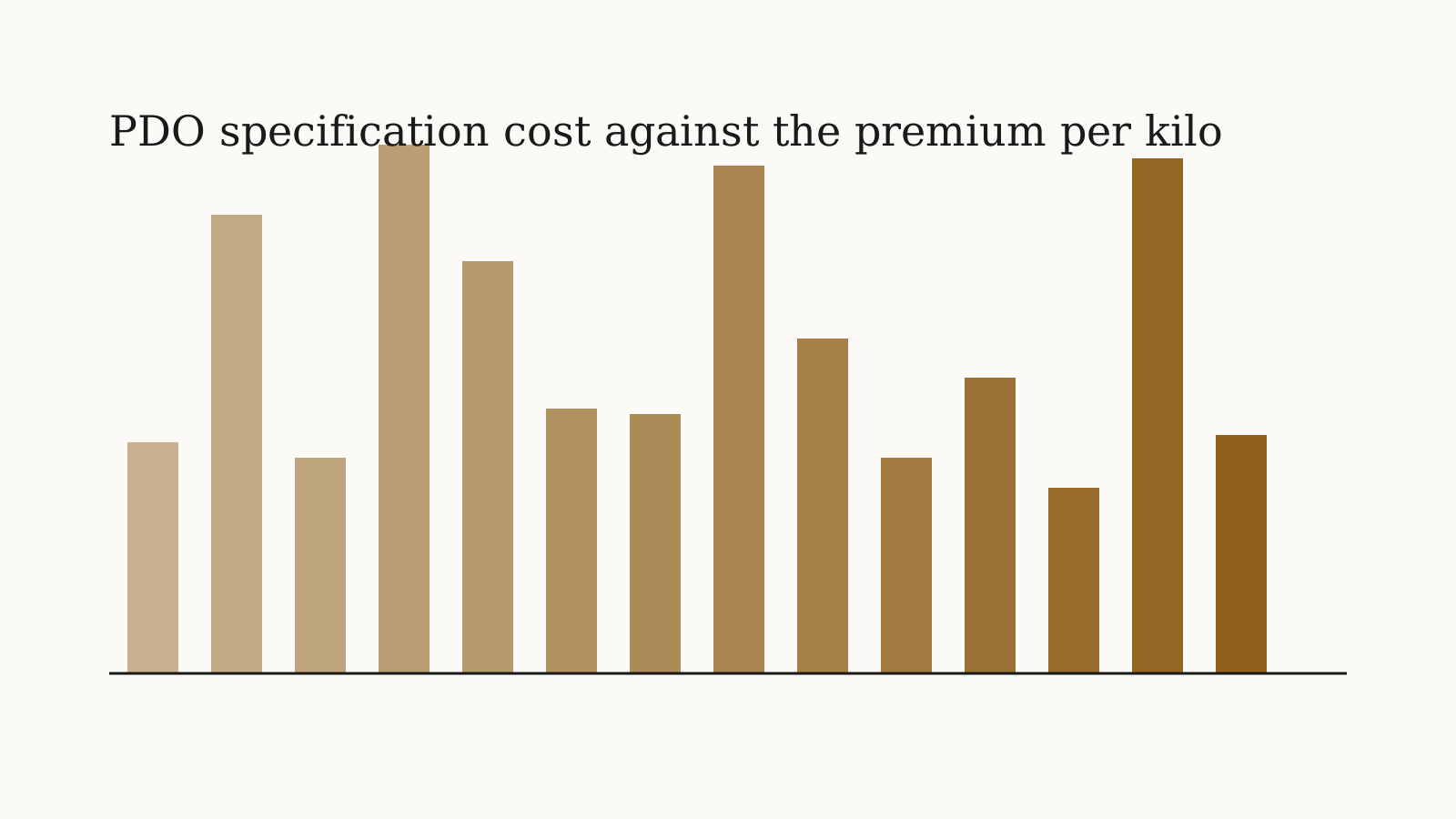
A protected designation of origin is not a label you win: it is a specification you accept, and it costs money. The Sagnes tomme application was lodged in 2024, it is working its way through, and for two years the local discussion has been about recognition.
That is not the variable that will decide it. What will decide it is the gap between what the specification imposes on each producer and what the designation brings back per kilo. That gap can be computed, and it does not come out with the same sign for all eleven.
11producers
signed up to the application
96t/yr
annual output of Sagnes tomme
5.3t/yr
the volume below which the designation costs more than it earns
2024
year the PDO application was lodged
What the specification requires
Three items dominate, and none is optional. Herd feed first: a minimum share of forage from the designated area, which rules out buying in from outside the zone in dry years. Then ageing, with a floor duration that ties up stock and therefore cash. Then inspection, billed per dairy, regardless of volume produced.
All three can be priced, and the certifying body sent the group its schedule in January. Inspection and certification come to 2,400 euros per dairy per year, whatever the tonnage. Ageing taken to ninety days ties up extra stock and costs the cheese part of its weight: 700 euros on average. The forage requirement, finally, costs 1,000 euros in a year like 2025, when growth inside the area fell short and the top-up had to stay within the zone, so cost more. Total: 4,100 euros per dairy per year.
It is that total that creates the asymmetry, because it does not depend on volume. An inspection costs roughly the same for a 4-tonne dairy as for an 18-tonne one.
The premium per kilo, as observed elsewhere
No local figure exists, since the designation has not been granted. What can be looked at is what other mountain tommes recorded after recognition: the observed range is narrow, from 0.65 to 0.90 euro a kilo three years after publication, and it is a long way from the multiples announced at meetings. The figure used here is 0.78 euro, the middle of that range.
The sum follows. A dairy earns 780 euros per tonne produced and pays 4,100 euros of new charges whatever its tonnage. It breaks even at 4,100 divided by 780, that is 5.3 tonnes a year. Below that the designation costs it money; above it, the designation pays, and the faster the larger the dairy.
The 96 tonnes are not evenly spread. The five largest dairies make 18, 14, 12, 11 and 9 tonnes; four others sit between 5.5 and 8 tonnes; the last two make 3.5 and 2 tonnes. The threshold therefore falls between the ninth and the tenth: it comfortably covers the new charges for the five largest, barely covers them for four, and does not cover them at all for two.
The amounts say the rest. The largest dairy clears 9,940 euros a year. The 5.5-tonne one clears 190, which is nothing. The 3.5-tonne one loses 1,370 euros, the 2-tonne one loses 2,540. Taken together the eleven gain 29,780 euros — the designation is profitable for the group, and loss-making for two of its members.
I am not against the designation. I am saying that for my dairy it is a cost, and that is not settled by telling me it is good for the group.
What the group can still decide
Two mechanisms exist and are used elsewhere: a group subscription proportional to volume rather than per dairy, and pooled inspection fees. Both shift the burden from the small to the large, and both are in the group's hands, not the administration's.
Their effect fits on one line. The new charges total 45,100 euros across the eleven dairies. Spread by volume, they come to 470 euros a tonne. The 2-tonne dairy would then pay 940 euros instead of 4,100 and turn a 620-euro profit; the 3.5-tonne one would gain 1,085 euros instead of losing 1,370. Not one of the eleven would be out of pocket. The largest dairy, for its part, would see its gain fall from 9,940 to 5,580 euros — that is the exact price of the operation, and it is read on one side of the table only.
Neither of those two mechanisms appears in the statutes lodged in 2024.
So what is at stake for those two dairies is not recognition, it is a line in the statutes that nobody has reopened. The application can succeed and cost two producers out of eleven — the sum has been done, it is simple, and it has been public since March.
Two dairies out of eleven is 5.5 tonnes out of 96, or 6 % of the volume. The group may decide the loss is bearable. It will then have to explain, on the day the designation is published, why a designated area with eleven producers has nine.